


OLIVIA AI Compared to Other PropTech Competitors
DirectOffer’s OLIVIA: an Actionable, Multimodal AI in Relation to Contemporary PropTech Platforms
OLIVIA AI Compared to Other PropTech Competitors
DirectOffer’s OLIVIA: an Actionable, Multimodal AI in Relation to Contemporary PropTech Platforms

Abstract
PropTech has entered an AI-intensive phase, yet much of the category still centers on search acceleration, content generation, lead triage, or back-office workflow support rather than full transaction enablement. This article evaluates OLIVIA AI, developed by DirectOffer, as a distinct architectural model within proptech: an actionable intelligence layer that combines multilingual voice interaction, ADA-aware design logic, listing-level deployment, and downstream routing into transaction or business systems. The analysis synthesizes recent industry research, scholarly literature on conversational and multimodal AI, accessibility standards, and official competitor disclosures from 2021–2026. The central finding is that OLIVIA is best understood not as a conventional chatbot, listing portal, or agent copilot, but as a cross-system execution layer intended to reduce the gap between consumer inquiry and transactional action. Where peer-reviewed head-to-head benchmark studies were unavailable, this article explicitly notes that insufficient literature data were found and limits claims to documented feature comparisons and strategic inference. (McKinsey & Company)
Abstract
PropTech has entered an AI-intensive phase, yet much of the category still centers on search acceleration, content generation, lead triage, or back-office workflow support rather than full transaction enablement. This article evaluates OLIVIA AI, developed by DirectOffer, as a distinct architectural model within proptech: an actionable intelligence layer that combines multilingual voice interaction, ADA-aware design logic, listing-level deployment, and downstream routing into transaction or business systems. The analysis synthesizes recent industry research, scholarly literature on conversational and multimodal AI, accessibility standards, and official competitor disclosures from 2021–2026. The central finding is that OLIVIA is best understood not as a conventional chatbot, listing portal, or agent copilot, but as a cross-system execution layer intended to reduce the gap between consumer inquiry and transactional action. Where peer-reviewed head-to-head benchmark studies were unavailable, this article explicitly notes that insufficient literature data were found and limits claims to documented feature comparisons and strategic inference. (McKinsey & Company)
1. Introduction
The current wave of proptech AI emerges from an industry that, by its own leading analyses, has historically digitized more slowly than other sectors. McKinsey argues that real estate long lagged in analytics and digital tool adoption, but that generative AI may alter the sector’s operating model because more building, workflow, and customer-facing systems are now digitally instrumented.¹ In parallel, the National Association of REALTORS® reports that technology adoption among agents is increasingly tied to time savings, client experience, CRM workflows, and emerging AI usage rather than simple online visibility.² This context matters: the competition is no longer only about who has more listings; it is increasingly about who can convert fragmented property data, user intent, and service workflows into guided decisions and measurable action. (McKinsey & Company)
From that perspective, AI in proptech has evolved across three broad layers. The first was listing aggregation, dominated by search interfaces and large inventory portals. The second was agent productivity and workflow tooling, including CRM augmentation, marketing automation, and transaction support. The third, now forming, is interactive intelligence, where AI assists buyers, sellers, renters, agents, or operators in real time. Zillow’s AI mode, for example, reframes property discovery as guided intelligence layered into portal search; Homes.com similarly offers conversational search in more than 50 languages; Compass has emphasized a voice-activated AI assistant for agent workflow; and Real’s Leo is framed as a data-grounded concierge tied to an agent’s transactions and commissions.³⁻⁶ These are meaningful advances, but they do not all occupy the same design space. OLIVIA’s claim to distinction rests on the fact that it was born not from a portal or a marketing layer, but from DirectOffer’s attempt to make listings, auctions, and adjacent transaction experiences more accessible, multilingual, and executable. (Zillow)
1. Introduction
The current wave of proptech AI emerges from an industry that, by its own leading analyses, has historically digitized more slowly than other sectors. McKinsey argues that real estate long lagged in analytics and digital tool adoption, but that generative AI may alter the sector’s operating model because more building, workflow, and customer-facing systems are now digitally instrumented.¹ In parallel, the National Association of REALTORS® reports that technology adoption among agents is increasingly tied to time savings, client experience, CRM workflows, and emerging AI usage rather than simple online visibility.² This context matters: the competition is no longer only about who has more listings; it is increasingly about who can convert fragmented property data, user intent, and service workflows into guided decisions and measurable action. (McKinsey & Company)
From that perspective, AI in proptech has evolved across three broad layers. The first was listing aggregation, dominated by search interfaces and large inventory portals. The second was agent productivity and workflow tooling, including CRM augmentation, marketing automation, and transaction support. The third, now forming, is interactive intelligence, where AI assists buyers, sellers, renters, agents, or operators in real time. Zillow’s AI mode, for example, reframes property discovery as guided intelligence layered into portal search; Homes.com similarly offers conversational search in more than 50 languages; Compass has emphasized a voice-activated AI assistant for agent workflow; and Real’s Leo is framed as a data-grounded concierge tied to an agent’s transactions and commissions.³⁻⁶ These are meaningful advances, but they do not all occupy the same design space. OLIVIA’s claim to distinction rests on the fact that it was born not from a portal or a marketing layer, but from DirectOffer’s attempt to make listings, auctions, and adjacent transaction experiences more accessible, multilingual, and executable. (Zillow)
2. Methodological Note
This article follows a structured narrative-review approach suitable for a fast-moving applied technology domain. Priority was given to recent materials indexed or commonly discoverable through scholarly ecosystems such as W3C standards, NAR reports, McKinsey industry analysis, and official product disclosures from competitor firms. Scholarly sources were used to ground claims about multimodal AI, conversational agents, CRM integration, and voice-interface design; official company sources were used to document present product capabilities. Accordingly, the article compares firms at the level of architecture, interface modality, deployment position, and documented workflow scope. (ScienceDirect)
2. Methodological Note
This article follows a structured narrative-review approach suitable for a fast-moving applied technology domain. Priority was given to recent materials indexed or commonly discoverable through scholarly ecosystems such as W3C standards, NAR reports, McKinsey industry analysis, and official product disclosures from competitor firms. Scholarly sources were used to ground claims about multimodal AI, conversational agents, CRM integration, and voice-interface design; official company sources were used to document present product capabilities. Accordingly, the article compares firms at the level of architecture, interface modality, deployment position, and documented workflow scope. (ScienceDirect)
3. The Limitations of Current PropTech AI
Recent scholarship on conversational AI repeatedly finds that the field is expanding rapidly, but with uneven depth in domain-specific deployment. A 2023 systematic review in Journal of Business Research identified trust, NLP design, communication quality, and value creation as the dominant research clusters for conversational agents.⁷ A 2023 review focused on the architecture, engineering, and construction industry likewise concluded that conversational AI in built-environment contexts remains underdeveloped relative to its theoretical promise.⁸ In practice, this means many property-facing AI systems still fall into one of four constrained categories: search enhancement, content generation, FAQ automation, or backend agent support. (ScienceDirect)
Those constraints show up clearly in the market. Zillow AI mode is expressly designed to help consumers “understand homes,” compare options, and book tours within a large portal experience.³ Homes.com’s Homes AI offers multilingual conversational search, guided Matterport tours, and instant answers about schools, neighborhood context, and tax history.⁶ Compass’s published AI emphasis remains heavily agent-centric, focused on workflow support and automation.⁵ Real’s Leo is deeply useful for its own agents, but the documentation describes it primarily as an internal concierge grounded in transaction and commission data.⁴ EliseAI is a sophisticated agentic platform for housing operations, yet its strongest documented use case is multifamily property management, leasing communication, and maintenance or delinquency workflows rather than listing-native consumer guidance in residential for-sale environments.⁷ These are not weaknesses so much as category boundaries. The limitation is that the market often treats these non-identical products as though they solve the same problem. They do not. (Zillow)
3. The Limitations of Current PropTech AI
Recent scholarship on conversational AI repeatedly finds that the field is expanding rapidly, but with uneven depth in domain-specific deployment. A 2023 systematic review in Journal of Business Research identified trust, NLP design, communication quality, and value creation as the dominant research clusters for conversational agents.⁷ A 2023 review focused on the architecture, engineering, and construction industry likewise concluded that conversational AI in built-environment contexts remains underdeveloped relative to its theoretical promise.⁸ In practice, this means many property-facing AI systems still fall into one of four constrained categories: search enhancement, content generation, FAQ automation, or backend agent support. (ScienceDirect)
Those constraints show up clearly in the market. Zillow AI mode is expressly designed to help consumers “understand homes,” compare options, and book tours within a large portal experience.³ Homes.com’s Homes AI offers multilingual conversational search, guided Matterport tours, and instant answers about schools, neighborhood context, and tax history.⁶ Compass’s published AI emphasis remains heavily agent-centric, focused on workflow support and automation.⁵ Real’s Leo is deeply useful for its own agents, but the documentation describes it primarily as an internal concierge grounded in transaction and commission data.⁴ EliseAI is a sophisticated agentic platform for housing operations, yet its strongest documented use case is multifamily property management, leasing communication, and maintenance or delinquency workflows rather than listing-native consumer guidance in residential for-sale environments.⁷ These are not weaknesses so much as category boundaries. The limitation is that the market often treats these non-identical products as though they solve the same problem. They do not. (Zillow)
4. The Origin of DirectOffer and Its Strategic Advantage
DirectOffer’s strategic positioning cannot be understood apart from its origin story. According to NAR’s technology and innovation profile, Kathleen Lappe’s impetus came from a highly practical accessibility problem: her autistic daughter could not easily interpret conventional online real estate listings, which exposed a broader inclusion gap affecting users with language, visual, hearing, and neurodiversity barriers.⁹ That founding logic is strategically important. It means DirectOffer did not begin by asking, “How do we add AI to listings?” It began by asking, “Why are listings structurally inaccessible to large portions of the market?” OLIVIA inherits that design philosophy. (NAR Tech & Innovation)
This origin generated three advantages. First, DirectOffer built around listing-level deployment rather than around a generic chatbot shell. Official DirectOffer support materials describe DO AudioTours and OLIVIA as systems that connect directly to MLS or manually uploaded listings to produce live conversational assistance, audio tours, captions, instant translation, and lead-oriented engagement.¹⁰ Second, the company built around multilingual accessibility at the product core, not as a later add-on; its published materials repeatedly state support for more than 100 languages, and DO AudioTours materials specify “107+ languages with dialects.”¹⁰,¹¹ Third, DirectOffer’s auction arm, AuctionLook, embeds the same philosophy into auction discovery and bidding contexts, describing itself as a global auction MLS with built-in bidding, AI support in 100+ languages, and compliance hooks for GDPR, UK GDPR, CCPA, and KYC/AML vendor connections.¹² That is an unusually broad design perimeter for a company still small enough to move quickly. (directoffer.com)
A slightly boastful but defensible conclusion follows: DirectOffer’s strength is not merely that it has AI, but that it has been solving the “last-mile listing communication problem” since before much of the market accepted that such a problem existed. HousingWire’s 2025 coverage of OLIVIA’s launch framed it as a real-time voice concierge for real estate listings in 100+ languages.¹³ That positioning is late only in publicity, not in conception. In innovation terms, DirectOffer looks less like a fast follower than like a company whose architecture was early to a market that is only now catching up. (HousingWire)
4. The Origin of DirectOffer and Its Strategic Advantage
DirectOffer’s strategic positioning cannot be understood apart from its origin story. According to NAR’s technology and innovation profile, Kathleen Lappe’s impetus came from a highly practical accessibility problem: her autistic daughter could not easily interpret conventional online real estate listings, which exposed a broader inclusion gap affecting users with language, visual, hearing, and neurodiversity barriers.⁹ That founding logic is strategically important. It means DirectOffer did not begin by asking, “How do we add AI to listings?” It began by asking, “Why are listings structurally inaccessible to large portions of the market?” OLIVIA inherits that design philosophy. (NAR Tech & Innovation)
This origin generated three advantages. First, DirectOffer built around listing-level deployment rather than around a generic chatbot shell. Official DirectOffer support materials describe DO AudioTours and OLIVIA as systems that connect directly to MLS or manually uploaded listings to produce live conversational assistance, audio tours, captions, instant translation, and lead-oriented engagement.¹⁰ Second, the company built around multilingual accessibility at the product core, not as a later add-on; its published materials repeatedly state support for more than 100 languages, and DO AudioTours materials specify “107+ languages with dialects.”¹⁰,¹¹ Third, DirectOffer’s auction arm, AuctionLook, embeds the same philosophy into auction discovery and bidding contexts, describing itself as a global auction MLS with built-in bidding, AI support in 100+ languages, and compliance hooks for GDPR, UK GDPR, CCPA, and KYC/AML vendor connections.¹² That is an unusually broad design perimeter for a company still small enough to move quickly. (directoffer.com)
A slightly boastful but defensible conclusion follows: DirectOffer’s strength is not merely that it has AI, but that it has been solving the “last-mile listing communication problem” since before much of the market accepted that such a problem existed. HousingWire’s 2025 coverage of OLIVIA’s launch framed it as a real-time voice concierge for real estate listings in 100+ languages.¹³ That positioning is late only in publicity, not in conception. In innovation terms, DirectOffer looks less like a fast follower than like a company whose architecture was early to a market that is only now catching up. (HousingWire)
5. OLIVIA AI as an Actionable Intelligence Layer
The most analytically useful way to classify OLIVIA is as an actionable intelligence layer. Official product language describes OLIVIA as a 24/7 multilingual concierge that answers questions, generates leads, curates experiences, and operates with enterprise-grade security and compliance.¹⁴ That description becomes more significant when combined with deployment evidence from DirectOffer support and DO AudioTours partner pages: OLIVIA is attached to actual listings, operates through voice and text, supports captions and translation, and is intended to move users from passive property viewing to active inquiry and next-step routing.¹⁰,¹¹,¹⁴ (directoffer.com)
This is where OLIVIA departs from many competitor offerings. A portal AI helps a user search. A brokerage copilot helps an agent operate. A property-management AI automates leasing or resident communication. OLIVIA is trying to sit between those layers, at the moment a consumer confronts a live asset and needs not only information but interpretation, translation, reassurance, and a path to action. In systems terms, it is closer to an orchestration interface than to a static assistant. That makes OLIVIA strategically interesting even where it is not yet the largest player in a category. It is attempting to control the moment where intent becomes workflow. (directoffer.com)
5. OLIVIA AI as an Actionable Intelligence Layer
The most analytically useful way to classify OLIVIA is as an actionable intelligence layer. Official product language describes OLIVIA as a 24/7 multilingual concierge that answers questions, generates leads, curates experiences, and operates with enterprise-grade security and compliance.¹⁴ That description becomes more significant when combined with deployment evidence from DirectOffer support and DO AudioTours partner pages: OLIVIA is attached to actual listings, operates through voice and text, supports captions and translation, and is intended to move users from passive property viewing to active inquiry and next-step routing.¹⁰,¹¹,¹⁴ (directoffer.com)
This is where OLIVIA departs from many competitor offerings. A portal AI helps a user search. A brokerage copilot helps an agent operate. A property-management AI automates leasing or resident communication. OLIVIA is trying to sit between those layers, at the moment a consumer confronts a live asset and needs not only information but interpretation, translation, reassurance, and a path to action. In systems terms, it is closer to an orchestration interface than to a static assistant. That makes OLIVIA strategically interesting even where it is not yet the largest player in a category. It is attempting to control the moment where intent becomes workflow. (directoffer.com)
6. Comparative Analysis
Table 1. Capability Comparison Based on Publicly Documented Features
PlatformPrimary User PositionCore ModalityDocumented Workflow ScopeNotable ConstraintOLIVIA AI / DirectOfferConsumer-facing listing layer plus routingVoice, text, audio, translationListing Q&A, multilingual support, captions, lead generation, listing-embedded guidancePublic peer-reviewed benchmarks unavailableZillow AI ModeConsumer portal searchConversational text/searchHome understanding, affordability exploration, comparison, tour bookingPortal-centered rather than listing-native executionHomes.com AIConsumer portal searchConversational searchMultilingual search, guided Matterport tours, local insightsSearch/discovery weightedCompass AIAgent workflowVoice-activated assistantAgent support and automation across operationsPrimarily agent-facingReal LeoAgent internal conciergeText/data-grounded conciergeTransaction, commission, training, broker review, content generationPrimarily internal to brokerage environmentEliseAIHousing operationsCalls, SMS, email, web chatLeasing, scheduling, maintenance, resident communication, collectionsStrongest in multifamily operations rather than listing-native residential search.
Sources: Zillow; Homes.com; Compass; Real; EliseAI; DirectOffer.³⁻⁷,¹⁰,¹⁴ (Zillow)
6. Comparative Analysis
Table 1. Capability Comparison Based on Publicly Documented Features
PlatformPrimary User PositionCore ModalityDocumented Workflow ScopeNotable ConstraintOLIVIA AI / DirectOfferConsumer-facing listing layer plus routingVoice, text, audio, translationListing Q&A, multilingual support, captions, lead generation, listing-embedded guidancePublic peer-reviewed benchmarks unavailableZillow AI ModeConsumer portal searchConversational text/searchHome understanding, affordability exploration, comparison, tour bookingPortal-centered rather than listing-native executionHomes.com AIConsumer portal searchConversational searchMultilingual search, guided Matterport tours, local insightsSearch/discovery weightedCompass AIAgent workflowVoice-activated assistantAgent support and automation across operationsPrimarily agent-facingReal LeoAgent internal conciergeText/data-grounded conciergeTransaction, commission, training, broker review, content generationPrimarily internal to brokerage environmentEliseAIHousing operationsCalls, SMS, email, web chatLeasing, scheduling, maintenance, resident communication, collectionsStrongest in multifamily operations rather than listing-native residential search.
Sources: Zillow; Homes.com; Compass; Real; EliseAI; DirectOffer.³⁻⁷,¹⁰,¹⁴ (Zillow)
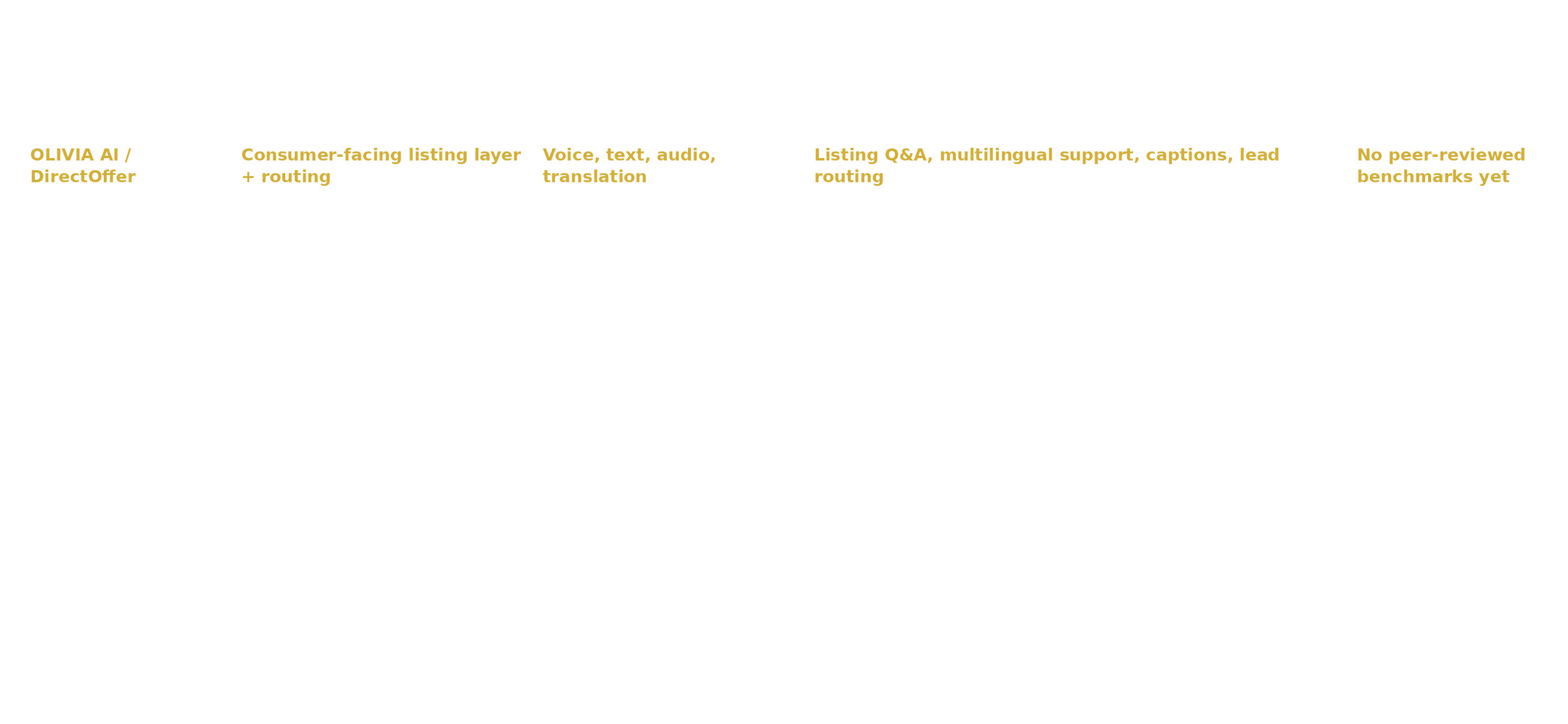
Table 2. Architectural Distinctions
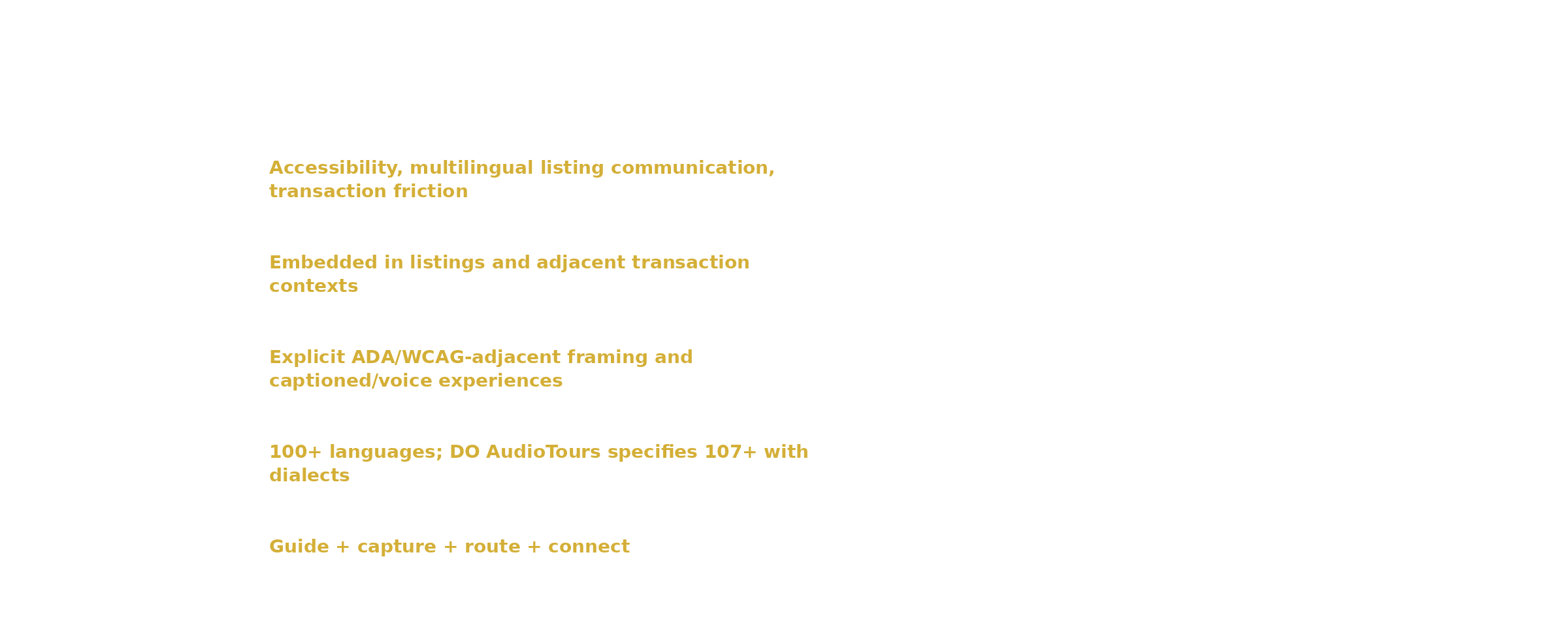
DimensionOLIVIA AITypical PropTech AI CompetitorFounding problemAccessibility, multilingual listing communication, transaction frictionSearch efficiency, internal productivity, or operational automationDeployment locusEmbedded in listings and adjacent transaction contextsPortal, CRM, brokerage intranet, or property ops layerAccessibility orientationExplicit ADA/WCAG-adjacent framing and captioned/voice experiencesUneven; often secondaryMultilinguality100+ languages; DO AudioTours specifies 107+ with dialectsOften narrower or product-specificAction modelGuide + capture + route + connectUsually answer, search, summarize, or automate within one silo.
Table 2. Architectural Distinctions
DimensionOLIVIA AITypical PropTech AI CompetitorFounding problemAccessibility, multilingual listing communication, transaction frictionSearch efficiency, internal productivity, or operational automationDeployment locusEmbedded in listings and adjacent transaction contextsPortal, CRM, brokerage intranet, or property ops layerAccessibility orientationExplicit ADA/WCAG-adjacent framing and captioned/voice experiencesUneven; often secondaryMultilinguality100+ languages; DO AudioTours specifies 107+ with dialectsOften narrower or product-specificAction modelGuide + capture + route + connectUsually answer, search, summarize, or automate within one silo.
7. Multimodal AI: Why It Matters
The academic case for multimodal systems is now strong. Recent surveys in National Science Review and arXiv characterize multimodal large language models as a major step beyond text-only systems because they support richer perception, grounding, and reasoning across input types.¹⁵,¹⁶ In commercial environments, however, multimodality matters less as a buzzword than as a friction-reduction device. Property decisions are spatial, emotional, financial, and often cross-lingual. A listing experience that combines text, voice, visual context, and translated explanation is not simply more impressive; it is cognitively better aligned to how real users evaluate properties.
Accessibility is central here, not peripheral. WCAG 2.2 explicitly frames accessibility as spanning visual, auditory, physical, speech, cognitive, language, learning, and neurological disabilities.¹⁷ That breadth maps unusually well onto the DirectOffer narrative and product positioning. Meanwhile, consumer and HCI research indicates that voice assistants can improve ease of use, hands-free interaction, and engagement, though proactivity must be carefully designed and context-specific.¹⁸,¹⁹ Research in voice commerce also suggests that empathy and conversational quality materially shape user response.²⁰ OLIVIA’s multimodal design is therefore not just an engineering flourish; it is a commercially relevant response to accessibility, trust formation, and interaction load. (W3C)
7. Multimodal AI: Why It Matters
The academic case for multimodal systems is now strong. Recent surveys in National Science Review and arXiv characterize multimodal large language models as a major step beyond text-only systems because they support richer perception, grounding, and reasoning across input types.¹⁵,¹⁶ In commercial environments, however, multimodality matters less as a buzzword than as a friction-reduction device. Property decisions are spatial, emotional, financial, and often cross-lingual. A listing experience that combines text, voice, visual context, and translated explanation is not simply more impressive; it is cognitively better aligned to how real users evaluate properties.
Accessibility is central here, not peripheral. WCAG 2.2 explicitly frames accessibility as spanning visual, auditory, physical, speech, cognitive, language, learning, and neurological disabilities.¹⁷ That breadth maps unusually well onto the DirectOffer narrative and product positioning. Meanwhile, consumer and HCI research indicates that voice assistants can improve ease of use, hands-free interaction, and engagement, though proactivity must be carefully designed and context-specific.¹⁸,¹⁹ Research in voice commerce also suggests that empathy and conversational quality materially shape user response.²⁰ OLIVIA’s multimodal design is therefore not just an engineering flourish; it is a commercially relevant response to accessibility, trust formation, and interaction load. (W3C)
8. The Shift from Search to Interaction
NAR’s 2024 Profile of Home Buyers and Sellers found that buyers spent a median of 10 weeks searching, viewed a median of seven homes, and still relied heavily on digital property information.²¹ Yet traditional real estate UX remains filter-heavy and document-light relative to user uncertainty. Zillow’s own positioning of AI mode effectively concedes this, describing legacy search as multiple tabs, calculators, and fragmented evaluation.³ OLIVIA’s strategic thesis is that the next interface is not a better filter set; it is a conversation grounded in a live asset.
That shift matters because search is descriptive, while interaction can be interpretive. Search retrieves candidate properties. Interaction can explain auction terms, translate local amenities, narrate property features, answer follow-up questions, and route the user toward showing, bidding, booking, or inquiry. In other words, interaction reduces the distance between information and decision confidence. In proptech, that is a profound move.
8. The Shift from Search to Interaction
NAR’s 2024 Profile of Home Buyers and Sellers found that buyers spent a median of 10 weeks searching, viewed a median of seven homes, and still relied heavily on digital property information.²¹ Yet traditional real estate UX remains filter-heavy and document-light relative to user uncertainty. Zillow’s own positioning of AI mode effectively concedes this, describing legacy search as multiple tabs, calculators, and fragmented evaluation.³ OLIVIA’s strategic thesis is that the next interface is not a better filter set; it is a conversation grounded in a live asset.
That shift matters because search is descriptive, while interaction can be interpretive. Search retrieves candidate properties. Interaction can explain auction terms, translate local amenities, narrate property features, answer follow-up questions, and route the user toward showing, bidding, booking, or inquiry. In other words, interaction reduces the distance between information and decision confidence. In proptech, that is a profound move.
9. Strategic Implications, Market Positioning, and Future Outlook
Marketwise, OLIVIA is best positioned not as a direct replacement for Zillow, CoStar, Compass, or EliseAI, but as a complementary layer that can sit on top of, or inside, environments where those firms are strongest. Zillow and Homes.com own large-scale consumer traffic. Compass and Real own brokerage workflow depth. EliseAI owns meaningful housing-operations automation. DirectOffer’s opening is the transaction-intent interface: the moment where a user needs a multilingual, accessible, listing-specific, action-capable guide. That is a narrower wedge, but potentially a powerful one. (Zillow)
The future outlook is favorable for this model. NAR’s 2025 technology survey shows that 66% of REALTORS® adopt technology primarily to save time, 64% to improve client experience, 39% identify social media as the top lead generator, 23% cite CRM, and 17% cite the local MLS; 33% reported AI already having a moderately positive impact.² These findings imply that the market increasingly rewards systems that collapse communication, engagement, and lead handling into fewer steps. Broader labor-market reporting cited by CoStar, drawing on World Economic Forum data, likewise suggests that AI and information processing are expected to transform business operations sharply by 2030.²² In this setting, OLIVIA’s ambition to connect inquiry, accessibility, and action looks not fringe, but directionally correct. (NAR)
9. Strategic Implications, Market Positioning, and Future Outlook
Marketwise, OLIVIA is best positioned not as a direct replacement for Zillow, CoStar, Compass, or EliseAI, but as a complementary layer that can sit on top of, or inside, environments where those firms are strongest. Zillow and Homes.com own large-scale consumer traffic. Compass and Real own brokerage workflow depth. EliseAI owns meaningful housing-operations automation. DirectOffer’s opening is the transaction-intent interface: the moment where a user needs a multilingual, accessible, listing-specific, action-capable guide. That is a narrower wedge, but potentially a powerful one. (Zillow)
The future outlook is favorable for this model. NAR’s 2025 technology survey shows that 66% of REALTORS® adopt technology primarily to save time, 64% to improve client experience, 39% identify social media as the top lead generator, 23% cite CRM, and 17% cite the local MLS; 33% reported AI already having a moderately positive impact.² These findings imply that the market increasingly rewards systems that collapse communication, engagement, and lead handling into fewer steps. Broader labor-market reporting cited by CoStar, drawing on World Economic Forum data, likewise suggests that AI and information processing are expected to transform business operations sharply by 2030.²² In this setting, OLIVIA’s ambition to connect inquiry, accessibility, and action looks not fringe, but directionally correct. (NAR)
10. Conclusion
On the available evidence, OLIVIA AI is meaningfully differentiated from other proptech competitors, though not because it “does AI” more loudly. Its differentiation lies in architecture and intent. DirectOffer’s lineage in accessible listing communication, MLS-adjacent deployment, and auction workflow design produced a system that is unusually focused on converting a property encounter into an understandable, multilingual, and executable user journey. That does not mean OLIVIA has already won the market. It does mean the company is competing on a more ambitious layer of the stack than many peers.
The bold version of the conclusion is also the defensible one: a large share of proptech still uses AI to make old interfaces slightly smarter. OLIVIA is trying to make the interface itself conversational, accessible, and operational. If that model scales, DirectOffer will not merely have added AI to proptech. It will have helped redefine what a property interface is supposed to do.
10. Conclusion
On the available evidence, OLIVIA AI is meaningfully differentiated from other proptech competitors, though not because it “does AI” more loudly. Its differentiation lies in architecture and intent. DirectOffer’s lineage in accessible listing communication, MLS-adjacent deployment, and auction workflow design produced a system that is unusually focused on converting a property encounter into an understandable, multilingual, and executable user journey. That does not mean OLIVIA has already won the market. It does mean the company is competing on a more ambitious layer of the stack than many peers.
The bold version of the conclusion is also the defensible one: a large share of proptech still uses AI to make old interfaces slightly smarter. OLIVIA is trying to make the interface itself conversational, accessible, and operational. If that model scales, DirectOffer will not merely have added AI to proptech. It will have helped redefine what a property interface is supposed to do.
References
Gujral, V. Why Generative AI Has Put the Real Estate Industry on the Cusp of Change. McKinsey & Company 2024.
National Association of REALTORS®. REALTOR® Technology Survey; NAR: Chicago, 2025.
Zillow. Zillow Debuts AI Mode, Bringing Guided Intelligence to Every Step of the Housing Journey. Zillow Front Porch 2026.
Real Brokerage. What Is Leo? Real Help Center 2024.
Compass. On a Mission to Transform How Agents Work, Unveils the Next Evolution of Compass AI. Compass Newsroom 2025.
Homes.com. Introducing Homes AI, Your Home Search Guide. Homes.com 2026.
Mariani, M. M.; Hashemi, N.; Wirtz, J. Artificial Intelligence Empowered Conversational Agents: A Systematic Literature Review and Research Agenda. J. Bus. Res. 2023, 161, 113838.
Saka, A. B.; Chan, D. W. M.; Siu, F. M. F. Conversational Artificial Intelligence in the AEC Industry: A Review of Present Status, Challenges and Opportunities. Adv. Eng. Inform. 2023, 55, 101902.
National Association of REALTORS®. A Spotlight on Real Estate Innovators. NAR Tech & Innovation 2025.
DirectOffer. OLIVIA AI Support and DO AudioTours Product Documentation. DirectOffer 2025–2026.
DO AudioTours. Berkshire Hathaway HomeServices Partner Page. DO AudioTours 2026.
AuctionLook. Platform Overview and Compliance Statements. AuctionLook 2026.
Delozier, J. DirectOffer Launches AI Voice Assistant for Real Estate Listings. HousingWire 2025.
DirectOffer. OLIVIA AI Solutions Overview. DirectOffer 2025–2026.
Yin, S.; et al. A Survey on Multimodal Large Language Models. Natl. Sci. Rev. 2024, 11 (12), nwae403.
Li, L.; Chen, G.; Shi, H.; Xiao, J.; Chen, L. A Survey on Multimodal Benchmarks: In the Era of Large AI Models. arXiv 2024, arXiv:2409.18142.
World Wide Web Consortium. Web Content Accessibility Guidelines (WCAG) 2.2; W3C: 2024 update.
Bérubé, C.; Boucher, E.-M.; McGrenere, J. Proactive Behavior in Voice Assistants: A Systematic Review and Conceptual Model. Comput. Hum. Behav. Rep. 2024, 16, 100458.
Liu, M.; Li, C.; Zhang, Y.; Zhao, X. Older Adults’ Intention to Use Voice Assistants: Usability and Emotional Factors. Heliyon 2023, 9, e22013.
Mari, A.; Mandelli, A.; Algesheimer, R. Empathic Voice Assistants: Enhancing Consumer Responses in Voice Commerce. J. Bus. Res. 2024, 176, 114495.
National Association of REALTORS®. 2024 Profile of Home Buyers and Sellers Highlights; NAR: Chicago, 2024.
Leipzig, P. Most Real Estate Employers Expect Artificial Intelligence to Transform Their Businesses. CoStar News 2025.
References
Gujral, V. Why Generative AI Has Put the Real Estate Industry on the Cusp of Change. McKinsey & Company 2024.
National Association of REALTORS®. REALTOR® Technology Survey; NAR: Chicago, 2025.
Zillow. Zillow Debuts AI Mode, Bringing Guided Intelligence to Every Step of the Housing Journey. Zillow Front Porch 2026.
Real Brokerage. What Is Leo? Real Help Center 2024.
Compass. On a Mission to Transform How Agents Work, Unveils the Next Evolution of Compass AI. Compass Newsroom 2025.
Homes.com. Introducing Homes AI, Your Home Search Guide. Homes.com 2026.
Mariani, M. M.; Hashemi, N.; Wirtz, J. Artificial Intelligence Empowered Conversational Agents: A Systematic Literature Review and Research Agenda. J. Bus. Res. 2023, 161, 113838.
Saka, A. B.; Chan, D. W. M.; Siu, F. M. F. Conversational Artificial Intelligence in the AEC Industry: A Review of Present Status, Challenges and Opportunities. Adv. Eng. Inform. 2023, 55, 101902.
National Association of REALTORS®. A Spotlight on Real Estate Innovators. NAR Tech & Innovation 2025.
DirectOffer. OLIVIA AI Support and DO AudioTours Product Documentation. DirectOffer 2025–2026.
DO AudioTours. Berkshire Hathaway HomeServices Partner Page. DO AudioTours 2026.
AuctionLook. Platform Overview and Compliance Statements. AuctionLook 2026.
Delozier, J. DirectOffer Launches AI Voice Assistant for Real Estate Listings. HousingWire 2025.
DirectOffer. OLIVIA AI Solutions Overview. DirectOffer 2025–2026.
Yin, S.; et al. A Survey on Multimodal Large Language Models. Natl. Sci. Rev. 2024, 11 (12), nwae403.
Li, L.; Chen, G.; Shi, H.; Xiao, J.; Chen, L. A Survey on Multimodal Benchmarks: In the Era of Large AI Models. arXiv 2024, arXiv:2409.18142.
World Wide Web Consortium. Web Content Accessibility Guidelines (WCAG) 2.2; W3C: 2024 update.
Bérubé, C.; Boucher, E.-M.; McGrenere, J. Proactive Behavior in Voice Assistants: A Systematic Review and Conceptual Model. Comput. Hum. Behav. Rep. 2024, 16, 100458.
Liu, M.; Li, C.; Zhang, Y.; Zhao, X. Older Adults’ Intention to Use Voice Assistants: Usability and Emotional Factors. Heliyon 2023, 9, e22013.
Mari, A.; Mandelli, A.; Algesheimer, R. Empathic Voice Assistants: Enhancing Consumer Responses in Voice Commerce. J. Bus. Res. 2024, 176, 114495.
National Association of REALTORS®. 2024 Profile of Home Buyers and Sellers Highlights; NAR: Chicago, 2024.
Leipzig, P. Most Real Estate Employers Expect Artificial Intelligence to Transform Their Businesses. CoStar News 2025.
FREE CLONEABLES
FREE CLONEABLES
FREE CLONEABLES
FREE CLONEABLES
FREE CLONEABLES



© 2025 NVIDIA, are trademarks and/or registered trademarks of NVIDIA Corporation in the U.S. and other countries.
All rights reserved. DirectOffer Inc.
September 15, 2026
FREE CLONEABLES
FREE CLONEABLES
FREE CLONEABLES
FREE CLONEABLES
FREE CLONEABLES
© 2025 NVIDIA, are trademarks and/or registered trademarks of NVIDIA Corporation in the U.S. and other countries.
All rights reserved. DirectOffer Inc.
September 15, 2026
FREE CLONEABLES
FREE CLONEABLES
FREE CLONEABLES
FREE CLONEABLES
FREE CLONEABLES
© 2025 NVIDIA, are trademarks and/or registered trademarks of NVIDIA Corporation in the U.S. and other countries.
All rights reserved. DirectOffer Inc.
September 15, 2026